Whiskey in the Teapot

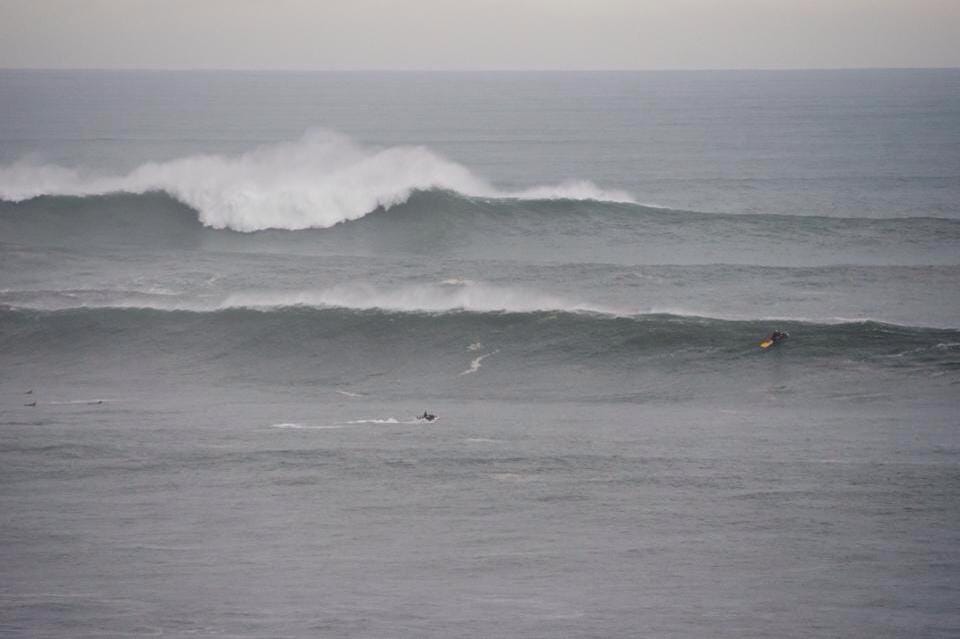
A GIANT WAVE loomed up in front of me. It completely blocked my view, so I couldn’t see if there was another one behind it. But I could hear a booming sound, which suggested to me that another wave was breaking out there somewhere. As I paddled over, all I could see was a white horizon. A wave of astronomical dimensions had broken on some reef, way, way outside where nobody had ever seen waves breaking before.
The other surfers in the line-up seemed oblivious. A young surfer I’d never seen before with a borrowed board was paddling around frantically, trying to catch any wave that came his way. Two people I’d also never met were trying to towsurf the end section, on a two-stroke jet ski with no rescue sled. The rip was so strong that you had to paddle continuously as hard as you could, just to stay in the same place. If anybody got into trouble out here, those guys wouldn’t have a clue what to do.
I began to wonder what the hell I was doing out here. The waves were well over 30 feet, which, nowadays doesn’t seem too much. But more than that, the ocean itself was out of control. I was the most experienced big-wave surfer by far, and I was out of my depth.
IT ALL STARTED 11 YEARS BEFORE. On Monday 10th March 2003, a big, clean swell hit the northern Spanish coast. I had to travel back to England, so my only experience of that swell was on the ferry, watching huge, thick lines of swell cross the boat’s path diagonally. I was awestruck, but frustrated. I knew somebody would be having a great time surfing big waves in my absence.
When I got back, people were talking about that swell. One of the spots mentioned was a giant lefthander that somebody had surfed in Asturias. I lived in the Basque Country, which had a thriving big-wave culture and a lot of famous spots. However, none of the people I surfed with had heard of any big-wave spots in Asturias, even though it was just a stone’s throw along the coast. I decided it was worth investigating.
Before I knew it, I was invited to meet some of the people who had surfed that big left, including the two surfers who had paddled out on 10th March. I was taken to an apartment overlooking the beach at Gijón, where they were both waiting for me.
Pablo Días was in his early 40s, of medium height and medium build, and was nothing like the popular image of a big-wave surfer. He had greying hair, pale skin and wore square, black-framed glasses. He spoke perfect English in a sophisticated, educated voice, albeit with a slight Brooklyn accent. He was an award-winning architect, and his understanding of technical concepts, like surfboard hydrodynamics, was way beyond any surfer or shaper I knew of.
Jesús ‘Chus’ Novas was younger than Pablo, most likely in his late 20s or early 30s. Unlike Pablo, Chus looked like the way people imagine a surfer. He had a wiry frame, blond hair and a thin face. He spoke with a quiet, shy voice, and his humility belied the fact that he was one of the best surfers in the country.
Pablo and Chus put on a slide show of that spot, apparently just for me. After the show, instead of waiting for me to start firing questions at them, they had questions of their own. What did I think of it? How does it compare with other big waves I had surfed? Should Pablo have paddled for that wave a bit earlier? I wondered why they were showing me, of all people, those images. After all, I didn’t really consider myself a famous surfer or big-wave rider. And, didn’t they want to keep their discovery to themselves?
In fact, it was quite the opposite. They wanted somebody else to see it. They wanted to find out if the wave they had discovered was a legitimate big-wave spot, if it was as big as those waves in Hawaii and California, the ones they had seen in the magazines.
The spot was called La Llastra, which means something like ‘large, flat rock’. But Pablo called it ‘La Verdad’ (the Real Thing) because he was convinced that it really was a proper big-wave spot. After seeing that slide show, I agreed. It was just as real as Maverick’s, Waimea or any of those famous places in the magazines. And it was certainly up there with the best in Europe, like Meñakoz or Guéthary.
From the pictures they showed me, I could see that La Verdad was big and powerful. But it had another quality that you don’t normally get with big-wave spots. It was long. Really long. It wasn’t just a peak, it was a long, long wall that held its size all the way down the line.
Pablo and Chus filled me in on the history behind La Verdad. It all started sometime towards the late 1990s, when a few local surfers managed to surf the end section. Swell conditions were pretty minimal, probably too small for the main wave to start breaking properly. The idea was just to test the water, see how it felt, and think about what it would be like on a bigger day.
It wasn’t until the end of the 1990s that Pablo and Chus made it out there on a proper big day. Somehow, they managed to get off the rocks just around the back of the peak, which, now I think about it, must have been a miracle. Once they reached the peak, they were blown away by the scale of the situation. The size of the waves and the vastness of the line-up were on another level. On boards that were suited to waves ten times smaller, it was impossible to catch the waves.
Then, around the beginning of the 2000s, Pablo made friends with a local boat-owner called Orlando. Orlando was willing to take him and Chus out there from the harbour, and did so several times over the next couple of winters. This was when the first big waves were surfed at La Verdad. At that point, nobody outside Asturias had the slightest clue that any of this was going on.
Until 10th March 2003.
After seeing those images and listening to that fascinating story, I felt I knew La Verdad already, even though I had never been there or seen it break. And these guys had welcomed me into their world, although I had only known them for a couple of hours. It felt a little surreal, as if I had been invited into the very story they were telling me.
I spent the whole summer of 2003 thinking about it. I drove to Asturias to visit Pablo; we talked at length about La Verdad, and I looked forward to seeing it break as soon as there was a good swell.
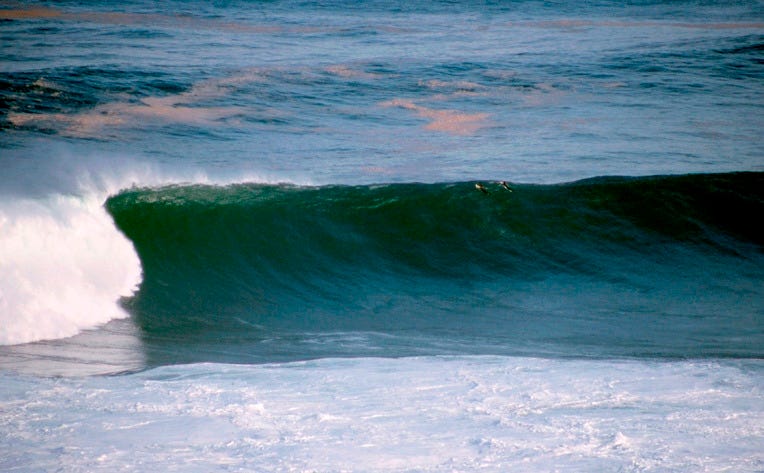
I CAN’T REMEMBER THE EXACT DATE, but it was probably sometime around November 2003. I pulled into the harbour and spotted Pablo’s 30-year-old family saloon with a white, ten-foot gun on the roof. The view of the open ocean was blocked by a giant wall, and all I could see was a harbour full of boats. The water in the harbour would flow gently in for a couple of minutes, then it would switch direction and flow out. Pablo was standing on top of the wall, so I climbed up there to join him.
The view was mesmerizing. The wave was about two kilometres away, lumbering towards me in slow motion, the tube morphing between square and round, opening and closing. Looking at it from this perspective, it seemed to be just churning away in the same place. Although, of course, that was an illusion, because, in reality, it was peeling and peeling for hundreds of metres. And the size? Difficult to estimate, but the slow-motion effect told me that it was at least 15 feet, probably bigger.
Pablo suggested we go round and check it from the front. This wasn’t just a walk along the cliff or a five-minute drive to another carpark; it meant driving to another town altogether, coming out the other side, negotiating a maze of tiny tracks, parking in the middle of a dense forest and walking down a steep slope where the break could be seen through the trees. All in all, this took about half an hour.
Just before we got there, Pablo told me some bad news. Orlando was no longer able to take anybody out in his boat. We would have to jump off the rocks. But we would try to find a better spot than where he and Chus jumped off that first day. And with my experience and Pablo’s ingenuity, he said, it would be a cakewalk.
We parked the car and walked down to the clearing where you could see the wave from the front. From here, you could really appreciate the length of the wave. A huge area of whitewater stretched out in front of us, and, looking towards the right, you could see the wave peeling away into the far distance.

The shoreline was a vision from Hell. Just in front of us was a giant plate of rock covered in slimy green algae, angled into the sea at about 45 degrees. The whitewater from each broken wave was around six feet high when it reached the shore, where it would turn into a giant uprush, like a beachbreak at high tide. You could see other plates of rock further out, sticking up at the same angle between the lines of whitewater.
Pablo told me how he and Chus had traversed across that plate onto a cobblestone beach. Somehow, they had both managed to paddle out there, and then paddle all the way out and around the peak. I told him I was too scared to even put one foot on that slippery thing. Losing my footing would mean a one-way ticket to the shorebreak where I would be trapped forever. Carrying a ten-foot gun wouldn’t make things any easier either.
Now, with all the variables laid out in front of me, I knew that paddling off the rocks would be insane, even if I could get to the paddle-out spot alive. I tried to get my head around the sheer scale of the place and the practicalities of surfing this wave. The whole thing seemed almost beyond human. Like a surf spot for giants. But I was determined to surf it, and we had to find a way to get out there.
I WENT BACK MANY TIMES over the winter 2003-2004. I would carefully examine the charts, discuss them with Pablo on the phone, and then drive from Euskadi to Asturias to meet him at the bottom of that harbour wall. Every time I hoped that this would be the day.
We got skunked a lot by the swell. Sometimes it would be too west and not get into La Verdad, or the tide wouldn’t get low enough for it to break. When it did break, there would sometimes be other problems. You might get this horrible side-swell on top of the main one, causing the wave to section like a giant moustache. Or you might get a local devil-wind coming up from the east, chopping up the wave faces. But sometimes, when all the conditions came together, it was just awesome. To stand there and watch these beautiful, giant, glassy waves peeling off into the distance in slow motion was hypnotic. Pablo and I would spend whole mornings standing there looking out from between the trees, totally absorbed.
That was all very nice, but the problem still remained: how to get out there. Every time I went home to the Basque Country, I would sit down and say to myself, “Next time, I don’t care, I’m going to get out there, whatever.” It was like, if I put in enough effort, looked hard enough, went back enough times, I would surely find a place to paddle out.
But I was living in a fantasy world. Because every time I got back to La Verdad and saw that it was still just as scary and dangerous as last time, I would say to myself, “What the hell was I thinking?”
Unbelievably, this went on for another five winters. And then, one day I got a call from Pablo. He had bought a jet ski. Now, he said, we could surf La Verdad any time we wanted. I was delighted, of course; but, at the same time, I had this small, nagging feeling that I might be giving in to the easy option. In the end though, I convinced myself that without some sort of motorized assistance, we might never get to surf it. After all, I had been waiting for six years.
Nowadays, I’ve upped my environmental principles to a different level. This includes becoming a firm believer that fossil-fuel powered machines should be kept well away from the line-up. If you need engines in the water to facilitate your surfing, you shouldn’t be surfing. But this is now and that was then.
THE WAVES WERE ABOUT 15 FEET and clean. Pablo was in the harbour with his new toy. It was November 2009, and some friends of his had also come along to see if they could surf another wave just along the coast. To get to that wave by jet ski, you had to drive past La Verdad, so Pablo agreed there would be no problem dropping me off at the peak.
In the carpark, there was a car with French plates and a couple of huge guns on the roof. I recognized the car from the recent trips I had made up to the French Basque Country to surf big waves. It was Pilou Ducalme.
Pilou was a wiry man in his early 40s, but looked a lot younger. He was full of enthusiasm and full of life, and, in many ways, reminded me of another fearless Frenchman: Philippe Petit, the man who tight-rope walked across the Twin Towers. Pilou was from Guethary, where I had first met him several years earlier. Guethary is the cradle of European big-wave surfing. Home to famous spots like Parlamentia and Avalanche, and home to famous big-wave surfers like Christoph Reinhardt and Peyo Lizerazu. But Pilou wasn’t as famous as those guys, even though he was just as much of a pioneer. He was a lot more interested in surfing big waves than becoming famous.
Like me, Pilou wasn’t interested in tow-in surfing. Last time I had seen him, he proudly showed me a 16-foot gun he had shaped using two surfboard blanks joined together end-to-end. This was to be used for Belharra, the famous outer reef off the Côte Basque. While others were towing into those monstrous waves, Pilou would paddle into them.
Pilou and I were dropped off at the peak, and the jet skis buzzed off into the distance. My heart was pumping. It wasn’t because of the size of the waves or the fact that we had been left there on our own; it was because I had finally made it into the water at La Verdad, after six years of waiting.
Before long, the horizon started filling up with lines, and we both switched into concentration mode. The set contained about five waves, glassy and smooth. Pilou caught one and disappeared, before re-appearing about 400 metres down the line. When he got back to the line-up, he told me what I wanted to know: that the wave was big, long and clean, and easy to surf. Then he told me he was going to go up to the other spot and try to paddle into those waves that the others were towing. I wasn’t interested in that. I just wanted to surf La Verdad.
After a few minutes, another set came, and I caught one. It was big, long and fast, just like Pilou had described, and pretty easy to surf on my 9’8”. When I kicked out, I felt a great sense of relief. At last, I had surfed La Verdad!
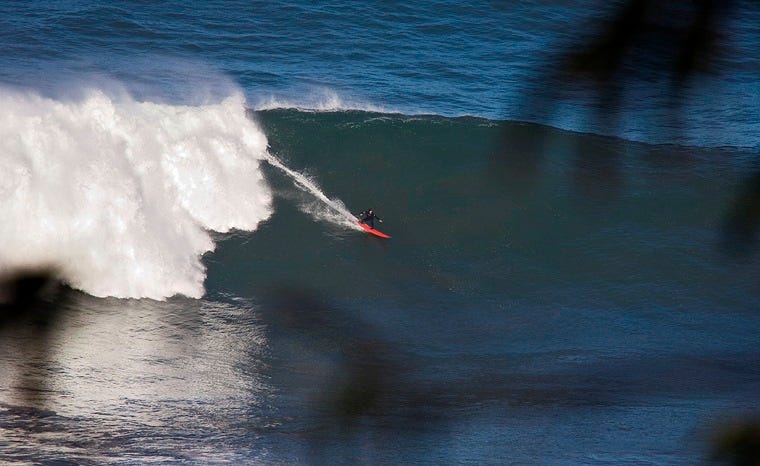
I didn’t even paddle back to the peak and catch another wave. I just sat there, in the channel, watching empty waves and letting the whole thing sink in. I don’t know how long I sat there; it could have been minutes or it could have been hours.
There was a more pragmatic reason why I didn’t paddle back to the peak. I was out there on my own, and I didn’t really have a Plan B. Pablo was about two kilometres up the coast and around the corner, and the harbour was about two kilometres in the other direction. That was too far to swim if I lost my board and/or got injured. In front of me was that treacherous shoreline, where swimming in would have probably meant a grizzly death from being smashed onto jagged rocks by a ten-foot shorebreak.
I waited for a while, to see if Pablo appeared. By now it was starting to get near dusk, and I realized that they must have completely forgotten about me, so I decided to paddle back to the harbour. I counted the paddle strokes: 2,400 strokes, in sets of 200, which took me about an hour. By the time I reached the harbour ramp, the adrenaline was starting to wear off, and I realized how tired I was. I felt like just flopping there on the ground, curling up and going to sleep there and then.
It was only during the drive home that the emotion started to wash over me – a mixture of relief, achievement and euphoria. I was in a kind of trance, listening to a haunting piece of classical music by Vivaldi. Now, all those years later, when I listen to that same music, it sends shivers down my spine and puts me right back in the water at La Verdad on that first day.
OVER THE NEXT THREE YEARS or so, I surfed La Verdad every time it broke. Sometimes, I would surf it on my own; other times, with a small crew of four or five local surfers. Occasionally, I would manage to persuade some of my Basque friends to join me: experienced big-wave riders like Ibon Amatriain, Mikel Agote or Jaime Fernandez. They all agreed that it was a legitimate big wave, just as heavy as the well-known Basque spots like Meñakoz or Roca Puta, but with its own unique set of delights, and dangers.
Another local boat owner stepped up and agreed to take us out there. Andrés ‘Primón’ Gallego, or Capitán Andrés as he became known, was a short, pot-bellied man with a bald head and a beaming, round face. He was a retired merchant seaman, probably in his early 60s, and now led a simple life, fishing and relaxing.
Andrés knew how to drive the boat, nobody doubted that. However, we weren’t sure if he had ever been out in big waves. He never wore a life-jacket or any other safety gear. Instead, he would sport a V-necked jersey, pressed trousers and slippery leather shoes – more suited to taking the wife to church on a Sunday than piloting a small boat in 20-foot waves. In fact, we wondered if he could even swim.
After each go-out, we would always treat Andrés to lunch. The lunches after each surf session became almost as legendary as the sessions themselves. To wash it down, Andrés would order a pot of tea with what he considered “a tot” of whiskey in it. Even though you could smell the alcohol from the other side of the room as he poured it out, he assured us that it contained almost nothing but water. We wondered whether he also had a tipple before taking us out, just for extra courage.
INEVITABLY, the wave at La Verdad started to become famous. Not just among the surfing population of Spain, but also among the local people of Asturias. In Spain, there had always been this rivalry between adjacent autonomous regions, each one claiming to be better than its neighbours, and Asturias was no exception. Now they could add La Verdad to their list of unique indigenous features, along with the flora, fauna and language. Now they could say that no other part of Spain – or, indeed, Europe – contained a surfing wave of such proportions.
They were right, of course. But they were blissfully unaware that publicising the wave might make it a victim of its own success. It might end up destroying the delicate balance, attracting too many greedy surfers, spoiling the wonderful experience.
I could already see this starting to happen. Often there would be two or three independent crews turning up from different parts of Spain, each with their own jet skis and their own ideas about how to surf the place. Sometimes, people wouldn’t even say hello.
Pablo and I were starting to get a bit paranoid. Pablo felt as if he had opened a can of worms by telling people (including me) of his discovery. I was worried that the place would turn into a circus, just like some other big-wave spots around the world, where inflated egos and inflatable vests took the place of experience and respect. For a while, we really thought it would come to that extreme.
On Monday 6th January 2014, it nearly did.
The North Atlantic had been off the scale all winter. Average wave heights were way above normal, with swells over 20 feet coming two or three times a week. Monday 6th January saw the biggest swell of the winter, and, in fact, one of the biggest of all time.
In the days running up to the storm, I checked the charts. I could see that the swell was going to be big, really big. However, it had a lot of west in it, and I was concerned it might not get into La Verdad.
In the end, that would be the least of my worries. I arrived at first light and joined Pablo on the harbour wall. The tide was still high and there were no waves breaking on the reef. I was right, I thought, the swell must be too west. I could see some swirling, boiling motion around the rocks though, which I thought was a bit weird. What I was seeing – although I didn’t realize at the time – was the long-period forerunners of the swell. Even though these waves were too small to break on the reef, they were so long and so powerful that they created fierce underwater currents, more like a tsunami than a normal ocean swell.
There were a few other surfers already checking it. People I didn’t recognize. They didn’t make much effort to say hello, either to Pablo, myself or to each other. Maybe they were nervous, I thought. Or maybe they just weren’t very friendly. Pablo looked at me and shrugged, as if to say “Who are these wankers?”
Andrés was faithfully waiting in his boat. A couple of surfers were already changed and loading their boards onto the boat. They were sure there would be rideable waves as soon as the tide got low enough. Alright, I thought, and ran back to the car to get ready.
From where the boat was parked, behind that giant harbour wall, the surf was hidden from view. But people didn’t seem to be bothered about checking it. They were more concerned about who should and shouldn’t be allowed on the boat. This all seemed a bit stressful to me, so I didn’t participate in the debate. Instead, I climbed up on the wall to check the swell. I still couldn’t see any surfable waves breaking, but I could see a lot more boiling motion around the rocks.
Back down in the harbour, I could also see a lot more water moving. The flow of water in and out of the harbour, which changed direction every couple of minutes, was really violent. The boats were pitching and rolling as if they were in a storm; the giant surges threatening to rip them off their moorings, smash them against the wall and suck them out to sea. I knew from my oceanographic studies that these hyper-long water movements – called infragravity waves – meant that the ocean contained a vast amount of energy.
None of the other surfers paid the slightest attention. Two people on a jet ski started doing laps around the harbour. The machine was a noisy, raspy two-stroke, and it had no rescue sled on the back. Before I could ask myself who these clowns might be, a six-foot wave came crashing around the side of the wall and nearly capsized the jet ski. I had never seen a wave break there before, even on the biggest days.
So I ran up to the top of the wall again. Now, I could see that the surf was gigantic. And it looked evil. The waves were jagged, savage-looking, with giant close-out sections and ragged faces at least 20 feet high. I couldn’t believe how it could have changed so quickly.
Back at the boat, Andrés’s phone rang. His mother wasn’t well and he needed to attend to her, so he was sorry but he couldn’t take us out today. I told him it was no problem and I hoped she would be alright, and thanks a million for coming.
The others looked disappointed, as if Andrés had neglected his duty or something. They started debating again, this time about how to get out there without the boat. Somebody suggested we just try to paddle out there. I wasn’t sure this was a good idea.
Nevertheless, I found myself trying to paddle out there with them. Once we got around the back of the harbour wall, you could literally feel the waves booming against the shore. The peak was about two kilometres away and we were already paddling as hard as we could against the current just to stay in the same place. By now, the prospect of actually doing any surfing today was the last thing on my mind.
At some point, Pablo pulled up alongside us and started ferrying us out there, two by two. When I found myself in the line-up – if you can call it that – it was truly frightening. I had already given up the idea of trying to surf; I just wanted everybody to get back to the harbour before anything went wrong. When Pablo said “I’m going to go round and start collecting everybody up”, I was relieved.
I still don’t know if those other surfers ever realized how dangerous it was. Or was it me being over-cautious? That evening, from the safety of my home, I contacted some of the most experienced big-wave surfers I knew: Jaime Fernandez and Ibon Amatriain in the Basque Country, Kohl Christensen in Hawaii. They all told me I was right: it was utter craziness to be out there that day, perhaps even irresponsible.
A few days later, I learned that the swell of 6th January 2014 – the Hercules Storm – was one of the biggest swells in history, not just in Europe, but worldwide. It caused untold damage to harbours and coastal cities, and eroded coastlines beyond recognition in France, Spain, Portugal and beyond. To be honest, I didn’t feel particularly proud that I had been in the water that day.
SINCE THAT DAY, I haven’t been back. I heard that people are surfing La Verdad, with some of the original crew fading away and a few newcomers; but, as far as I know, things haven’t got really out of hand there. Perhaps the place is too finnicky, too difficult to work out; perhaps people have been skunked too many times, or perhaps other places like Nazaré have taken the limelight.
Sadly, Capitán Andrés passed away in 2022. He took a big part of La Verdad with him. It’s difficult to imagine somebody as kind and willing – and brave. To me, Andrés represents the ‘golden era’ of La Verdad. A few precious years of discovery, excitement and camaraderie.