The Hollow Right

“At least it’s not raining” said Andy, as he peered out of the van. He was right: twenty-foot waves were closing out a mile from the beach and the wind was howling onshore; but at least it wasn’t raining. Andy ‘El Optimista’ was one of those people who could always see the positive side of a predicament. To make us all feel better, he would choose some absurd hypothetical situation that was worse than the one we were in. He would say things like “At least the van roof isn’t leaking” or “At least we’re not in Russia,” or something like that.
This time, I wasn’t convinced. Andy’s state of eternal bliss, because things could always get worse, didn’t cut it for me that day. We had been travelling around Galicia for five weeks and we had failed to find any good surf. Exposed, windswept beaches with huge, ragged swells, or sheltered spots with small, closed-out dumpers were all we could find. Ever-changing conditions, combined with a maze of tiny roads and a total lack of signposts, meant that the right spot at the right time was always just out of reach.
For the umpteenth time, I pulled out the map and spread it over the table.
“Hang on” said Ernie, his eyes darting across the map, out of the window and back to the map again. Ernie was a big-wave bodyboarder with a degree in electronic engineering and a brilliant mind. And I could tell he had an idea.
He was pointing to a stretch of northeast-facing coastline that looked completely different from the one we were on. It faced away from the main swell direction, which meant that the waves would be smaller but the wind would be offshore. And, instead of a convolution of headlands, beaches and cliffs, it was a straighter, flatter, low-lying section of coastline. Something told me it just might contain some good surf spots.
When we arrived, we could hardly believe our eyes. The swell was down to a reasonable size and the wind was a light offshore. There was a left pointbreak with a steep take-off followed by a fatter wall running into a deep bay. The whole set-up looked totally user-friendly. At least compared to what we had just come from.
We wondered why it was empty. I suggested we’d better get in the water before the locals turned up. So we parked the van some distance away, in between some other cars so that our foreign plates wouldn’t stand out. I had already had bad experiences with localism in other parts of Spain, including getting my car windows smashed and all my gear stolen. I had no reason to think that the locals here would be any different.
We paddled out and had a pretty sketchy surf. As the tide dropped out and that left turned into a semi-dry slab, Andy and I found it more and more difficult to take off, and, in the end, gave up and left it to Ernie.
“At least we got to surf”, said Andy. He was right – this was a hundred times better than the washed-out chaos we had just come from.
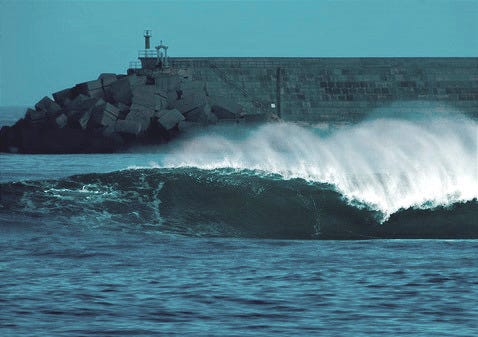
Bewildered, we drove into town for lunch. On the way back I noticed a righthand wave that we had somehow failed to notice earlier, even though it was just opposite that left. It was short but mechanically perfect, every wave breaking in the same spot. It had a bowling inside tube section that looked easy to tuck into, even for surfers like us.
In five minutes, we were out there. The wave was just as good as it looked, and we had it all to ourselves. By now, we were experts at inventing original names for surf spots, so we called it the ‘Hollow Right’.
For some reason, the locals never turned up. At that point, the thought never crossed our minds that there were actually no locals at the Hollow Right. Neither did it occur to us that we had just been the first people to surf it.
To reach the paddle-out, you had to walk through this row of abandoned, half-built chalets. After a few days, we started to notice a man walking around the site. He looked about 50 years old; short with incredibly broad shoulders. He wore a shirt and tie, with a thick, tweed jacket, and carried a stick. He had a booming voice that could be heard hundreds of metres away, and always waved his stick around while he was talking. I guessed he might have been a retired sergeant-major or something. When we surfed, that man would stand next to one of the chalets and watch us, for hours.
Each night, I would go to sleep with more questions than answers: Where were the locals? Why didn’t anyone surf the Hollow Right? Who was that mysterious old man and why was he there every day? I was starting to think I’d never find the answers to those questions.
Until we met Eladio Esteban. Eladio was from Madrid, but had moved to Galicia about ten years earlier. He was a quintessential Spaniard: short black hair, always well-dressed and clean, and always asking us if we liked bullfighting or chorizo, and if it was really true that in England people drove on the other side of the road. He was incredibly welcoming and invited us into his home, even though he must have thought we were a bunch of smelly, dirty hippies. Obviously, if there were any locals, and if they were anywhere near as friendly as Eladio, my initial preoccupation – that they would rob us or kick us out of the water – was shamefully unjustified.
Eladio was a surfer, but he had never tried to surf the Hollow Right. He told us that there were, indeed, other surfers in the area, some of them very good, but they tended to stick to the beachbreaks. Apparently, this was because ‘El Berberecho’ – the reef’s real name – was rock-bottomed and therefore too dangerous to surf. That seemed bizarre to me, especially after spending three months desperately searching for good reefbreaks along the coast of Galicia.
And who was that strange man patrolling the abandoned chalets every day?
“Ah yes,” Eladio said, “that’s the Casco Man.” The Casco Man was employed by the company who owned the chalets, and he had been there every day since Eladio could remember.
Nobody seemed to know much about those chalets. Perhaps they were illegal because they were too close to the sea, or perhaps the company had simply run out of money and stopped building. Eladio suspected something more sinister though. You see, Galicia is notorious for corruption and underworld crime, and the construction industry is a major part of it. This, he suggested, might be some sort of stalemate between clans, where the chalets never got finished but never got knocked down either. Whatever the case, they just stood there, rotting away, while the Casco Man patrolled them, day-in day-out.
We surfed the Hollow Right for the next 14 days. All that time, we never saw any other surfers paddle out there or even check it. We were blown away; it was as if we had our own private surf spot. We decided to come back as soon as we could, as many times as we could, before somebody else found out about it.
Over the next five years we made a lot more trips to the Hollow Right. We were students, so we would go down there over the Christmas and Easter holidays, for two or three weeks at a time. The wave was more consistent than we thought, even though it faced away from the main swell direction. It didn’t need much swell to work, plus the prevailing wind was offshore. But the most remarkable thing was, in all the trips we made, we never saw any other surfers at the Hollow Right.
Like those chalets, Eladio had a half-built house, although this one would eventually get finished. The upper part was a bare, open framework, but there was an underground garage that was more or less sheltered from the elements. Eladio kindly let us use it as our home every time we went down there. It had a flat floor to sleep on, room to stand up straight, and the rain only came in sometimes. For us, this was paradise.
Sometimes we would hear noises in the middle of the night. Probably rats after our food, or maybe a fox snooping around, we thought. But one night the noise was louder than normal, so I sat up and shone my torch towards it. The stooped figure of an old man scuffled away carrying a pile of wood, most of which he dropped on the floor with a clatter. A burglar? Stealing planks of wood? Why didn’t he steal our surfboards, or our shoes?
Next morning, Eladio had a smile on his face. His neighbour had come banging on his door earlier, frightened to death because last night somebody in the building site had pointed a gun at him. Apparently, the poor man, who was in his eighties, tended to hallucinate after a few drinks, and still wasn’t sure if the Spanish Civil War had ended or not. He would wander around, late at night, collecting firewood, sometimes mistaking a building site for a forest. When Eladio explained to him that we were harmless Englishmen, and not spies working for the Fascist Regime, the old man kindly offered us lunch. We were to go round there at two-o-clock.
I walked into the doorless house and took a step down the hall. To my left was a room I thought would be the lounge. Instead, there were two sheep looking up at me defiantly. To be honest, I had ever seen farm animals living inside people’s houses before.
To my right was the kitchen. There were empty bottles of wine, pieces of meat hanging up, and flies buzzing around. The old man proudly pointed to a huge, filthy pot containing a greasy yellow liquid with lumps of pink fat floating on top. Presumably this was to be our lunch.
I looked at Andy and Ernie. They both had “get me out of here, now!” written all over their faces. I made some excuse to the poor old man, and we went back to our cement campsite for bread and cheese.
Eventually, we stopped travelling down to the Hollow Right. My friends were busy with other responsibilities, and I had become obsessed with the big waves of the Basque Country. For the next few years I thought about travelling along the north coast and visiting Galicia, but I just couldn’t break away from the big-wave culture that I was so privileged to be a part of.
Meanwhile, the Hollow Right was discovered by some surfers from Ferrol. Ferrol is quite a large town, and, even in the early 1990s, was already home to quite a large surfing population. The surfers were experienced enough not to be afraid of rocks or steep takeoffs, but not experienced enough to understand how a surf spot could be affected by crowds.
Within a couple of years, every surfer in Spain knew about the Hollow Right. On the good days, you might find 30 people out there, crammed into that tight take-off area, with photographers lining the cliffs and disputes raging in the carpark.
It was a bittersweet feeling. On the one hand, I felt privileged to have been able to enjoy that wave for so many years, just myself and just two friends; and I ought to be happy with that. But on the other hand, it was frustrating to see how that place had become so crowded in such a short time, and to think that I would never enjoy it again like those first few years.
But all was not lost. Somehow, unbeknown to me, the popularity of the Hollow Right reached a peak, probably sometime around the mid-2000s. One of the nearby beachbreaks was found to have a special focusing effect, with bigger, longer barrels on the same swells. Gradually, more local surfers decided to go there instead of the Hollow Right, and, by around 2010, I started hearing rumours of less-crowded sessions and friendlier vibes.
In 2020, I went back there. A friend of mine had come over from South Africa, and I took him there to show him the spot and tell him the story. His name was Tony and he was a big-wave surfer in his mid-50s. He was small in stature but big on enthusiasm. Before we even got to the Hollow Right, I assured him it would be crowded. Besides, I only had an eight-foot gun in the car, which wasn’t the right board for that kind of wave.
As it turned out, there was only one person in the water. The waves were around five or six feet and perfect, so the only option was to paddle out. It all came back to me in a flash. It was as if that first session, almost 30 years before, had happened yesterday. My knowledge of the wave, programmed deep inside my memory, was still intact. Tony and I, plus our new friend Luis, a bodyboarder from Ourense, traded waves all afternoon. And, just like that first session, the locals never turned up.