Requiem
A surf sanctuary

I had to admit, I was feeling a bit depressed. Everywhere I turned, people would tell me that the ‘golden era’ of big-wave surfing never happened. How could I say that it was better thirty years ago, when nowadays people are riding bigger waves than ever? What I considered ‘big’ back then wouldn’t even register on the dial nowadays. Now, thanks to the safety of jet skis and inflatable vests, performance levels have skyrocketed, and people are doing things that would have been unthinkable a few years ago. Thanks to digital cameras and the internet, big-wave riding is able to entertain millions of people and generate thousands of dollars.
And that, they tell me, is what it is really all about. If I thought it had ever been any different, I was living in a fantasy world.
I wasn’t so sure. I was convinced that big-wave surfing wasn’t just about chasing numbers; it was about the whole experience: being immersed in Nature, getting away from the stresses of modern life, understanding the ocean and understanding yourself. But of course, trying to explain that to people was like trying to tell a clock how it feels to have an orgasm.
Nowadays, instead of being about the experience of surfing, it was about the experience of seeing pictures of yourself surfing, and seeing your friends' reactions to them. Instead of dancing with Nature, you would try to conquer Nature. Instead of getting away from the stresses of modern life, you would take them in the water with you. Instead of using your own ingenuity and experience to understand the ocean and face the dangers, you would buy a jet ski and an inflatable vest.
I couldn’t help remembering why I had been attracted to big waves in the first place. It was because I was getting fed up with the competitivity, commercialization and narcissism in small-wave line-ups; and big waves offered a way to get away from all that.
The reason I was feeling depressed, I figured, was the irony. The things I hated about small-wave surfing had now wormed their way into big-wave surfing. The things I had tried to run away from had caught up with me. As a result, it was becoming more and more difficult to find somewhere where I could surf big waves without being invaded by competitive surfers with jet skis, drones and photographers, or by inexperienced surfers with ten-foot guns, inflatable vests and no idea of the ocean.
My friend Michi was feeling the same way. Michi had been quietly surfing big waves for the last 20 years, scoring places like Jardim do Mar, Cloudbreak and Nazaré, way before they became famous.
On the surface we were like chalk and cheese. Michi was a giant and I was a midget. Michi’s boards were extra wide for his size 49 feet; mine were extra narrow for my small frame. Michi worked in the wholesale distribution industry; I studied oceanography.
But deep down we were very similar: We both got into big waves around the same time, for the same reasons. We both wanted to do something different and both wanted to get away from the stresses of terrestrial life. Neither of us were competitive people, in or out of the water, and we both felt claustrophobic in crowded and aggressive line-ups.
We were both from countries devoid of big waves, and we both knew we would never be famous big-wave riders. This, far from being a handicap, relieved us from the burden of trying. Each one of us knew that if the other one was still surfing big waves after 20 years, it must be for love, not money.
Crucially, Michi and I were both at a point where we were getting disillusioned with the big-wave scene and the direction it was going. We started thinking that there were no new spots to find, and no way to get back to that original feeling of freedom and discovery.
Until something totally unexpected happened.
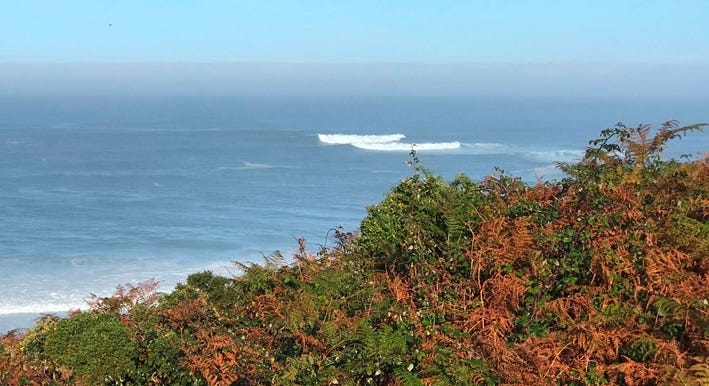
We stood at the top of a cliff. A hundred metres below us, waves crashed into jagged rocks, potentially shredding a board and surfer into a thousand pieces. About a kilometre out, a wave broke and peeled right. It wasn’t perfect, but it had a long wall and certainly looked rideable. I knew it was big because it had that dreamlike slow-motion effect. How big though, I couldn’t tell.
Inside the reef, there was a deeper area that turned into a cauldron of swirling water after each set. It was due to a rip current from the residual flow of the breaking waves, but I couldn’t tell which way it was going. On bigger days, would the waves still back off here, or would they roll through into the zone of certain death at the bottom of the cliff? There seemed to be another reef to one side of the main one, where I could see lines focusing but not breaking. Would this break on bigger days?
While all those questions ran through my mind, I was ignoring the obvious. There didn’t seem any way to get out there. What was the point worrying about all those things if I couldn’t even reach the spot in the first place? Apart from a beachbreak just along the coast, it was sheer cliffs and deadly rocks as far as the eye could see. The beachbreak received the full brunt of the swell, and I could see huge waves closing out with lines and lines of whitewater. We wouldn’t have a hope in hell of getting through that, I thought, especially on big-wave guns that you can’t duck-dive.
I came to the conclusion that the swell would have to be much smaller if we wanted to get out there. But if it was that small, the reef probably wouldn’t break. Maybe in the end the only way would be with a jet ski. Which was exactly what we didn’t want to do.
I couldn’t stop thinking about it, day and night. Maybe on a mega low tide, or a super long period swell, or maybe some swell direction where the beachbreak wouldn’t be so big.
In the far distance, about two kilometres away at the other end of the beach, there seemed to be a rip flowing out. Maybe on the right day you could just about squeak through there, but it was a long, long way from the reef.
Two weeks later we were back at the top of the cliff. The swell was a bit smaller and more organized than that first day, and the deep water area didn’t have that boiling, swirling look about it. We saw a set of about four waves break and it seemed almost user-friendly – not exactly ‘fun’ but not exactly suicidal either. The beachbreak was still massive though, and we knew it would be futile to try to get through it.
That rip-channel was still there, down at the other end of the beach. Michi and I looked at each other. What would happen if we tried to paddle out there? Would it be too far? Perhaps we ought to give it a go? We knew it was crazy, but it might be our only chance. We watched another couple of sets break, and then we headed over to the far end of the beach.
My mouth was dry and sticky. It was my own body’s way of telling me I was nervous. I distinctly remembered it from the first time I paddled out at Meñakoz, 28 years earlier. Now I was standing at the water’s edge, at the position where that rip was supposed to be. From this lower viewpoint, all I could see was whitewater. I started to doubt whether I could even get the first 100 metres off the beach.
I had read about Ocean Beach in San Francisco, the most famous paddle-out in the world. At Ocean Beach, you could surf perfect 15-foot waves, which was rare for a beachbreak. But you had to get out there first, which sometimes took more than an hour of battling against the whitewater – if you made it at all. I wondered what the people who surfed Ocean Beach would think of this place. The difference was that we weren’t paddling out here just to surf the beachbreak – we were on our way out to a quality big-wave reef. It was like paddling out at Ocean Beach to surf Maverick's.
Michi was already in the water, paddling like hell. So I jumped in and started following him. By weight and volume he was about one-point-six times bigger than me, so I figured that the waves would seem one-point-six times smaller for him. Before long he went out of sight, leaving me stuck in a sort of time-loop. What seemed like the same whitewater would keep appearing about five metres in front of me, which I would dive under, come up, climb on my board, start paddling and, bam! There it was again. And again. And again.
This ordeal lasted about an hour. Several times I came close to giving up and heading for the beach. But then, without warning, a clear area appeared in front of me, the light at the end of the tunnel. I sprinted towards it using every drop of paddling power I had left. My anxiety and self-doubt turned to strength and determination; all I could think of was getting out into that clear area before the next set bore down on me.
I made it. I was out of the woods. The sense of relief was overwhelming. All the nervousness and adrenaline melted away and left me blissfully floating in a glassy sea. I sat on my board and looked around me. The beach was a long way away, and the reef that we were supposed to be going to surf, was barely visible in the far distance. More worrying was the fact that Michi had completely disappeared.
I started paddling towards the reef, looking in all directions to see if I could spot him. Maybe he was already at the reef? Maybe he never made it and was back on the beach? Maybe something worse had happened? Then, I spotted his board, the sunlight glinting off it from about 500 metres away, way over towards the reef. I realized the vastness of the situation, and how easy it would be to lose somebody out here.
At the peak, the scale was something else. I had had this same feeling before, usually during the first session after a few months not surfing big waves. When a wave came, it seemed to just present itself about 100 metres further out from where I was sitting. Then it grew in size but didn’t seem to get any closer. It just reared up in the same place, ready to swallow me whole. Any paddling didn’t seem to make any difference; the wave was still there and I couldn’t get away from it. What was really happening, of course, was that my brain couldn’t comprehend the much bigger distances and relative speeds of me and the wave.
Gradually, I started to get used to the scale and feel a bit more comfortable out there. We managed to find some line-up markers, to the side and to the front. They were absolutely essential to triangulate your position and to see which way, if any, the current was taking you. Without line-up markers you could be out of position to catch a wave. Or, worse, you could get seriously caught inside.
We also kept our eye on the weather. Rain or fog would obscure the line-up markers, but could also make it difficult to get back to the beach if we lost sight of the coastline. I imagined us having to navigate our way back like the ancient Polynesians, using the feel of the swell and smell of the wind.
We started to get a basic idea of the anatomy of the spot. There was a kind of bubble, a place where the top of the wave sometimes capped before backing off slightly and then breaking with full force on the inside. This could be an easy way to catch the wave, I thought. It was scary though, because you’d be taking off behind the peak. This wasn’t a four-foot slab where you could backdoor the peak and tuck into the tube; it was a 20-foot monster that neither of us (perhaps nobody) had ridden before. We gradually paddled inside and sneaked a bit closer to that bubble.
Then, without warning, a wave broke in front of us. It looked like a giant version of Jeffrey´s Bay, freight-training from right to left. I stared, mesmerized, for a fraction of a second before diving under. I can still see the image in my mind of that thing rolling past.
Luckily, it was only one wave, and we were back in the line-up fairly quickly. And before I could get my bearings, Michi had paddled across to the bubble and stroked into a wave. The wave looked great from the back, and there was no sign of him floating in the impact zone, so I assumed he made it. I couldn’t see or hear him, so I just had to wait. When somebody else catches a big wave like that, there is always this ‘radio silence’ for a couple of minutes, like the Apollo going into re-entry.
After about two or three minutes I still couldn’t see him. I paddled in and to the side of the break looking towards the impact zone, hoping not to see a loose board floating on its own. But then I heard him hooting from way inside, and knew he was safe.
Now it was my turn.
In crowded and competitive line-ups, surfers are competing for a limited resource. Every man for himself, like rats fighting for a piece of cheese. In these situations, taking turns is usually not an option. In contrast, when there are only two or three people in the water and plenty of waves to go round, taking turns can work perfectly.
I thought about the rock climber, Tommy Caldwell, whom I had had the pleasure to meet once. Tommy is a humble and unintimidating person, despite being one of the world’s top climbers. In 2015, Tommy made it across the most difficult traverse of one of the most difficult rock climbs in history: The Dawn Wall. His climbing partner, Kevin Jorgeson, wasn’t having such luck. Kevin tried and tried, but couldn’t get across. Tommy could have carried on to the top on his own, becoming famous and proving beyond doubt that he was the better climber. But he didn’t. He waited several days for Kevin to finally make the traverse, so that they could both complete the climb together. Everybody already knew that Tommy was a fantastic climber. And now, everybody knew that he didn’t need to keep proving it.
Every day I wish surfing could be like that. Happily, this day, it was. Michi didn’t paddle back to the peak and try to catch another wave; he sat on the shoulder and waited for me to get my wave. Mine wasn’t quite as good as his, but I made the take-off and made it around the first section before getting swatted. I came up unscathed, my board was still in one piece and everything was alright. Michi was smiling. I was smiling. Together, we had both achieved our own ‘first descent’ of a new big-wave spot.
We decided to call it a day before we got too tired. We were aware that we still had to negotiate our way in through a 15-foot beachbreak. The adrenaline pumped again as I weaved through the impact zone, huge waves booming either side of me.
Before I knew it, we both were sitting on the beach, exhausted and elated. I started to realize the magnitude of what we had just done. It wasn’t necessarily the nuts and bolts of getting out there or the size of the waves or anything like that. It was more about the intensity of the experience. Four hours of deep concentration; my entire universe reduced to the waves, the reef and the rhythm of the sets. Anything belonging to the outside, to the before or after, ceased to exist. It was the most exciting one-wave session I had ever had. In fact, it felt like one of the most exciting experiences I had ever had in my life. I thought how experiences like these, where you get close to Nature and forget about everything else, were getting more and more rare, like an endangered species.
A gentle onshore wind picked up, and a light mist rolled in from the sea and up the side of the cliff. Apart from us, there was nobody on the beach, no cars in the carpark and no sign of human activity anywhere in the area.
Or so I thought. Until I heard the sound of bagpipes. That’s right, there was some guy standing on the clifftop playing the bagpipes. It wasn’t just my imagination or some hallucinogenic effect from all the adrenaline, because Michi saw him too. It wasn’t the piercing, rasping sound that you normally hear from bagpipes; it was a haunting melody, more like a medieval love song or a Portuguese fado. It was a requiem, a lament for the kind of surfing experience that our children and grandchildren might never have. It was a call for help, from the experience itself, to us, the people who need to keep it alive.