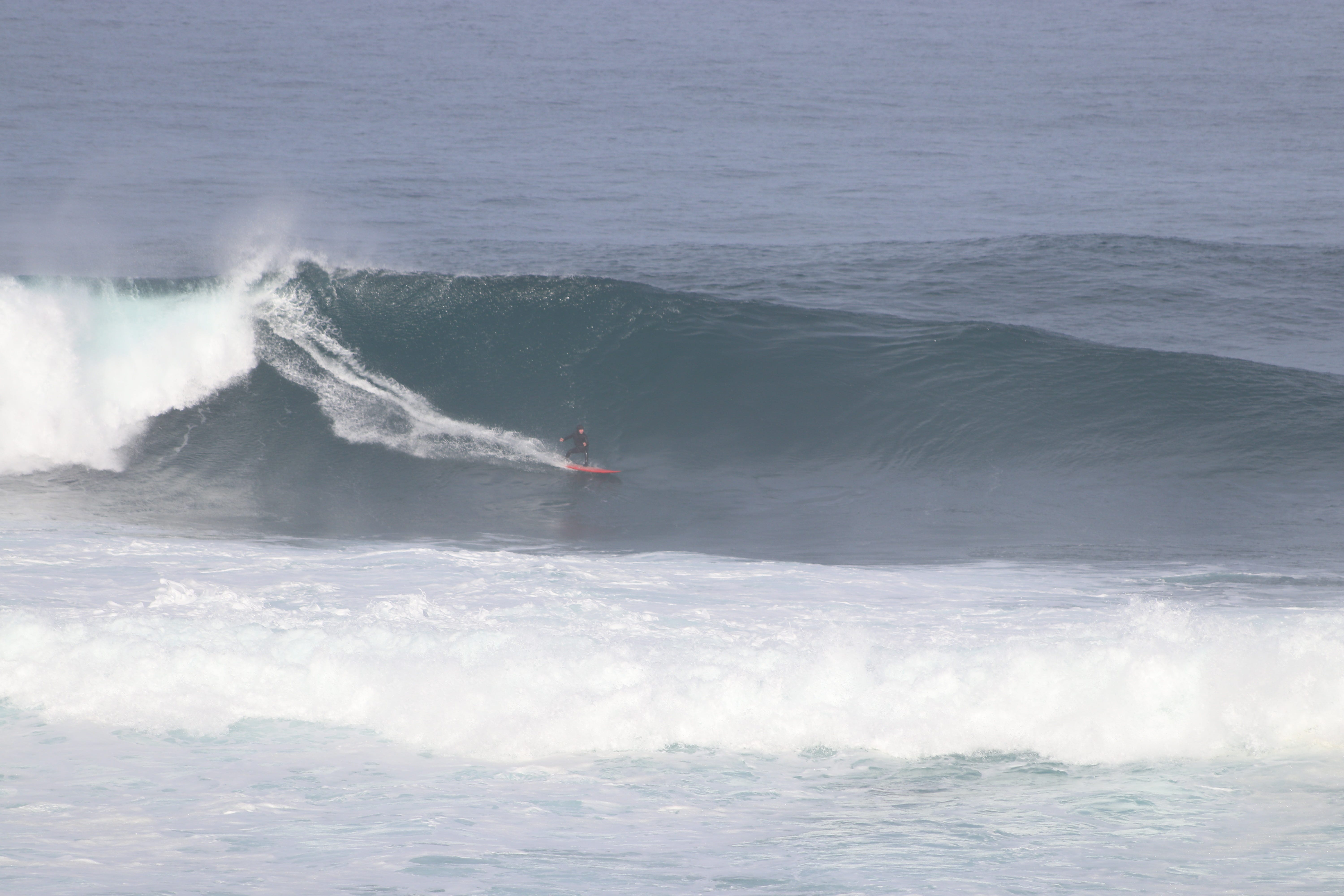
El Pringao

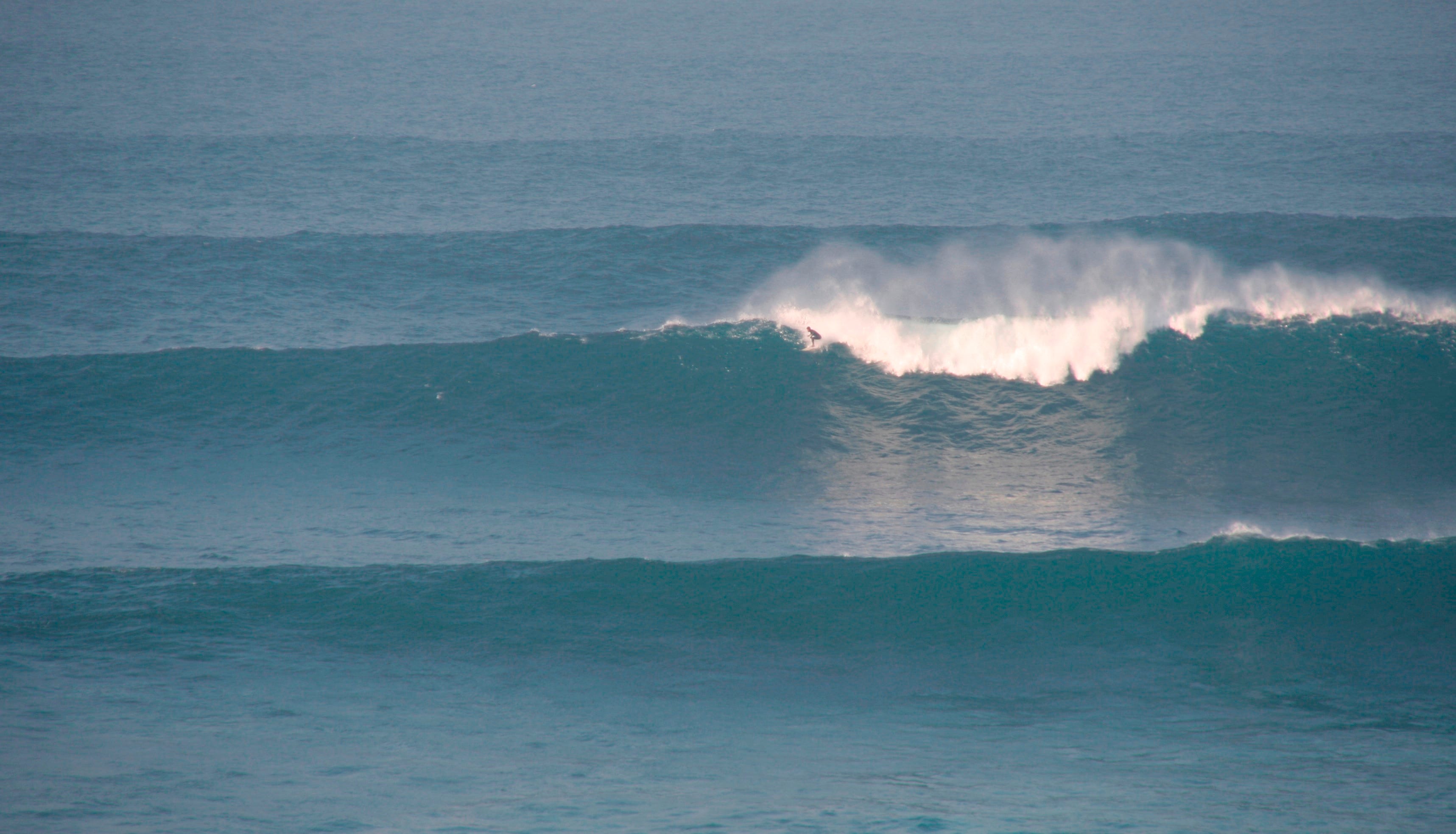
I PULLED UP AT THE TOP OF THE CLIFF. To the right, in the distance, I could see what looked like three- to-four-foot waves flopping over onto a reef before backing off into deep water. This must be it, I thought. I had no idea if anyone had ever surfed that spot before, or, indeed, if it was even a surf spot. All I knew was what a friend had told me a few weeks before: that he had seen “something interesting” along this stretch of coast.
I decided to give it a try. From my vantage point I reckoned it would take me about ten minutes to reach the peak. There was about an hour before dark, which would still give me plenty of time to scope it out. I took two boards out of the car, one of which I would leave on the small beach at the bottom of the cliff, just in case I snapped or lost the first one.
Down on the beach, things looked a bit more difficult. I couldn’t even see the surf spot beyond the whitewater of the shorebreak, which was now twice as big and four times as daunting as it looked from the top. But there was no going back.
In the end, it probably took me about half an hour to get to the break. Once I got there, I looked back. The beach was now a tiny strip of yellow sand in the far distance, surrounded by white foam and grey rocks. The rest of the surrounding coastline was jagged rocks and inaccessible cliffs. And what had looked like three-to-four-foot waves “flopping over onto a reef” were more like six to eight feet crashing onto a boil-infested slab.
I caught one wave and paddled back. When I got to the beach I climbed up to the car and got changed in the pitch dark. I forgot my other board so I had to fumble my way down the cliff path again to get it. On the way back up I met a fisherman on his way down. His clothes and fishing gear looked like they were from the 1930s, as if he had just come from the Spanish Civil War. I asked him what that reef was called, pointing to the whitewater barely visible in the distance. “El Pringao” he said, with a glint in his eye and a tiny smirk on his face. I looked out at the reef for a second and then looked back. The fisherman had vanished.
Fishermen and mariners have names for every reef, rock, island and sandbar; decades or even centuries before any surfers turn up and give them their own names. I wondered why that reef was called ‘El Pringao’. The word ‘pringado’ comes from the Spanish verb ‘pringar’ which means to dunk or soak. This makes sense if you think about a small boat being caught on the reef – maybe one or two fishermen had had a dunking there in the past.
But ‘pringado’ also means a gullible person; a sucker; someone easy to deceive.
I DROVE INTO THE NEARBY VILLAGE and asked if anybody had ever surfed El Pringao.
“What’s that?” they said.
“The big wave you can see from the top of the cliff,” I said, thinking it was obvious.
People just glared at me or shook their heads and walked away. I even found a small surf shop tucked away behind a chemist, where the owner didn’t seem to know anything about it either.
I stood on a corner, watching the people of the village go about their business. After coming from a town where almost everybody knew me, I felt wonderfully invisible. I drifted into thought, wondering what the story was behind that surf spot. It seemed strange that nobody knew about it, even in a surf shop. The only reason I could think of was that it wasn’t a legitimate surf spot. Maybe in a decent swell it closed out or something, or maybe there was a nasty backwash from those rocks.
My thoughts were interrupted by a bald-headed man on a bicycle calling me from the other side of the road. It was Javier, a well-known surfer from the area. Somehow, he already knew that I had just surfed that wave, not even two hours ago. I thought that was a bit weird, since nobody in the village even knew it, or me, existed. Or so they claimed.
He told me how he had been checking the spot every now and again for the last 15 years, but never actually got around to surfing it. He said that this coast wasn’t like the Basque Country where I had just come from. Around here there was no big-wave culture; and none of the local surfers were remotely interested in waves like El Pringao. The guy who owned the surf shop was from Madrid, and wouldn’t have recognized a big-wave spot if there was one in his bedroom.
This changed my thinking. Maybe under the right conditions it really was a good surf spot. Maybe the good days existed, but they were hidden under a veil of whitewater, rocks and lack of interest. That was why it had stayed under the radar for all that time. It reminded me of the famous Schrodinger’s Cat, isolated inside a sealed box. Until somebody opened the box, there was no way of knowing with any certainty whether the cat was dead or alive. With El Pringao, until somebody started surfing out there, nobody could know with any certainty whether the spot was any good or not.
Javier was interested in giving it a go, so about a week later we paddled out there together. I felt much more confident with somebody else to join me. The swell was pretty small, but it was much cleaner than that first day, and there was some long intervals between sets where things calmed down significantly. This time, instead of paddling out from the beach, we scrambled over the rocky shoreline and around the other side of the break. We found a place to jump off in the middle of a swirling mass of moving water, scratched our way over inside breakers sucking dry on jagged rocks, and made it to the line-up.
After riding a handful of waves each, we managed to get out the way we came in. From the safety of the headland we both agreed that the place had good potential as a surf spot, but doubted it could be surfed much bigger.I mean, where would you paddle out? And how would you get back in? What would you do if you lost your board?
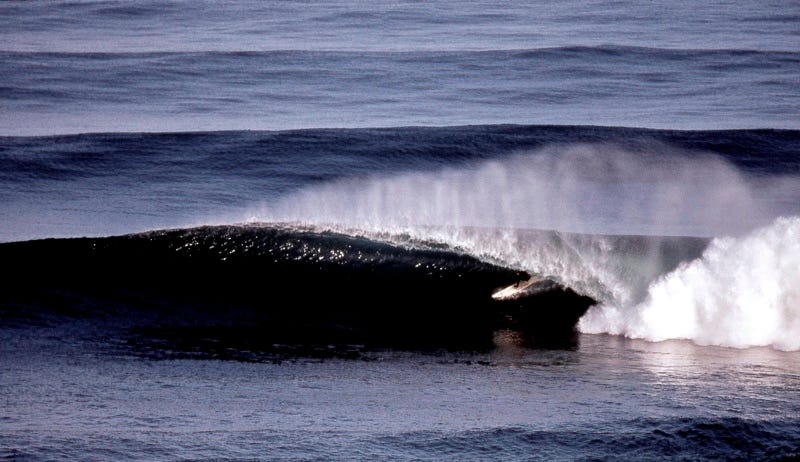
OVER THE NEXT TWO OR THREE WINTERS, I was basically left to obsess about it on my own. I had a lot of sessions out there by myself, mostly on smallish or medium swells. I would always paddle out from that first beach, about a kilometre from the break, as it still seemed too risky trying to jump off the rocks on the other side. Once I was out there, I always made sure not to fall off or get caught by a set, and usually only caught a handful of waves each time. On bigger days I would just sit and watch for hours, trying to make sense out of what looked like a confused mix of shifting peaks, dry suck-outs, and nowhere to go if you got caught inside.
It took me a long time before I realized there was second reef, further out from the one I had been surfing. The outside peak was just as scary and broke bigger than the inside one, but it was more predictable. On the right swell, the outside peak connected with the inside one, giving a longer ride and the chance to drive through a fast inside section. I was beginning to realize, on rare days when everything came together, El Pringao could be a really good big-wave spot; perhaps even as good as those waves in the magazines.
I started to venture out on bigger days with a bigger board, and my confidence started to grow. I gradually began to see a channel here, an opening there, and, before I knew it, the big days began to look a lot more practical. With the right combination of swell and tide and long enough lulls between sets, you could surf it much bigger than I originally thought.
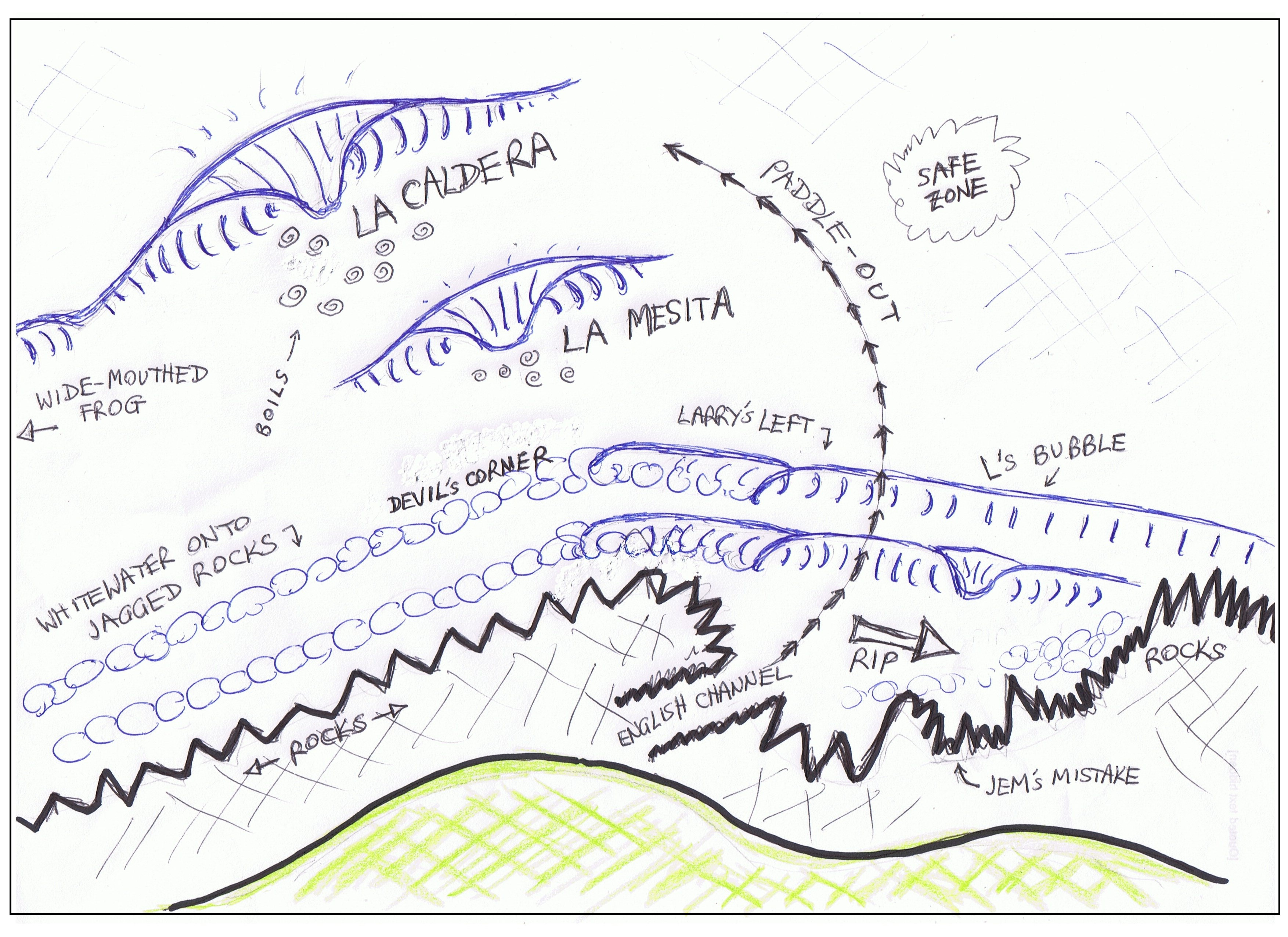
On big days with low tides you could see huge swirling boils at the bottom of the wave as you were taking off, which gave it an extra scariness. I called the outside peak ‘La Caldera’ (The Boiler) because of those boils, and the inside section ‘La Mesita’ (The Table) because of its slab-like qualities.
Little by little, El Pringao began to reveal its secrets to me. I began to see things I had never imagined before. From what seemed like an unintelligible jumble of whitewater, rocks and swirling currents, I could now make out clearly-defined peaks, rips and channels. It was like learning a new language: at first all you hear is a rapid fire of garbled sounds, but eventually you learn to isolate those sounds and make sense of them.
Every time I went out there I made a mental note of each part of the reef and carefully chose the corresponding line-up markers on the land. I gave names to them all. I identified safe and unsafe sections of the shoreline, gave names to various different waves on the inside, and carefully noted how the rips and boils behaved in different conditions. Then, back on the land, I would frantically write everything down and draw sketches, to preserve the fragile new orderliness, as if it would collapse back into chaos if I didn’t document it as quickly as possible.
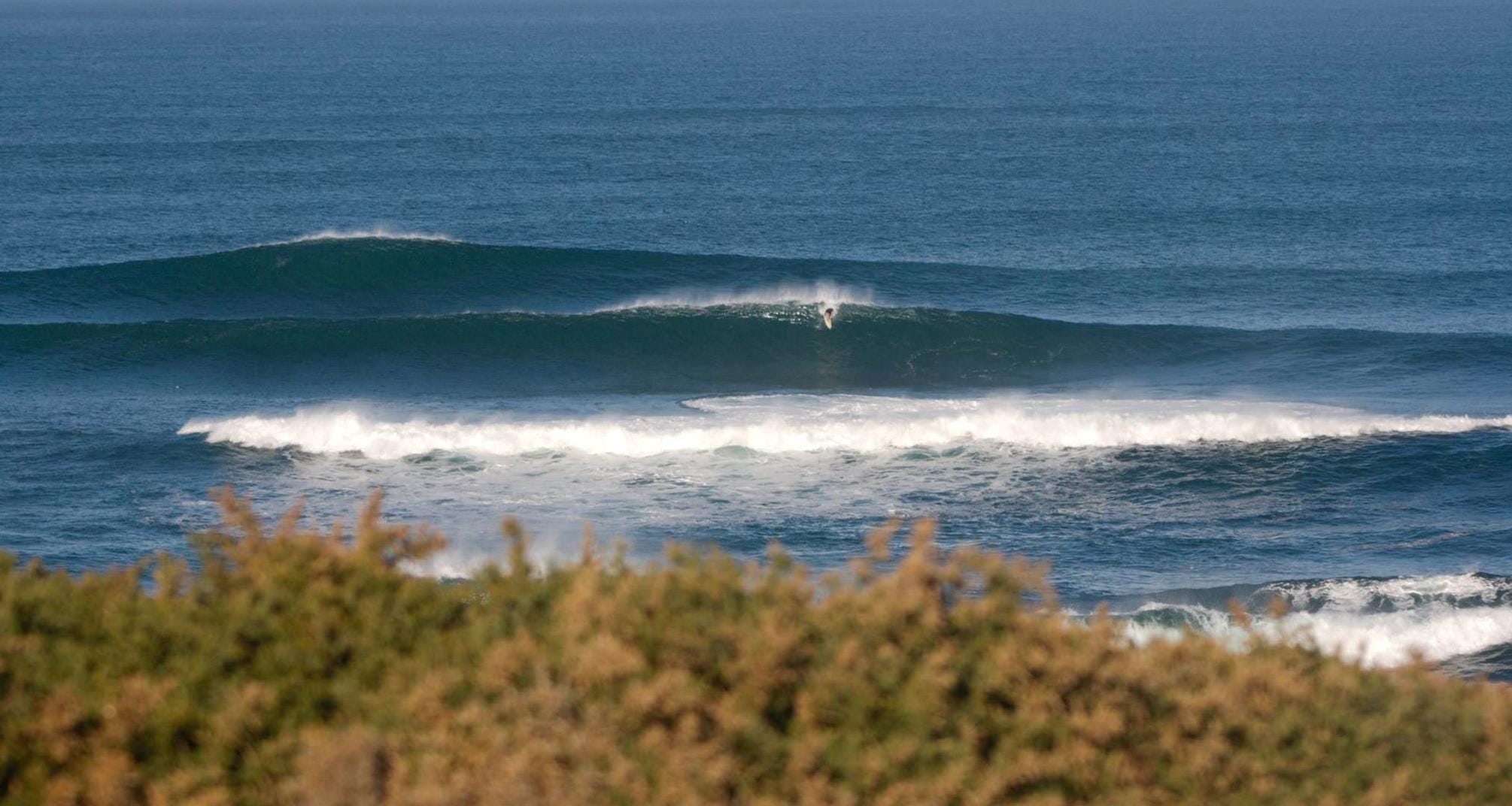
FOR THE NEXT FIVE YEARS OR SO, my biggest problem was getting somebody to join me out there. To be honest, sometimes I was simply too scared to paddle out on my own. I would desperately phone and send messages to other surfers up and down the coast. If they couldn’t make it themselves, I would beg them to try and find somebody else:
“Pleeease, send me someone, anyone”, I would say. If nobody came and it was big, I would usually just sit on the cliff and mind-surf those waves.
A lot of people who came were totally inexperienced in big waves. But they were good surfers and strong swimmers. I would lend them boards and leashes, show them where to paddle out, where to take off and how to get back in again. I was delighted to share my knowledge and see other people enjoying themselves. I felt proud of my discovery.
Needless to say, the thought did cross my mind whether one day it might actually get crowded. “No way”, they said, “Of course it will never get crowded. The place will protect itself.”
I guessed they were right. The place was downright scary. Then again, I kept thinking about the famous story of Jeff Clark at Maverick’s. Clark surfed Maverick’s for years, alone and desperate for somebody else to paddle out there with him: “I’d check all the beaches, I’d stop at all the surf shops, like ‘come on, let’s go surf the biggest waves around’, and, nobody wanted any part of it,” he said.
And even when other people started to surf Maverick’s, around 1992, he was still convinced that the place would take care of itself: “You guys at the magazines will do your thing, but it will eventually pass. Maverick’s isn’t going anywhere. There’s only a certain amount of people who are going to want to ride it.”
In the end, of course, he was wrong. In the space of a few short years, the situation went from one man desperately trying to find somebody else to join him, to a crowd of 50 or more surfers, even on the biggest, gnarliest days
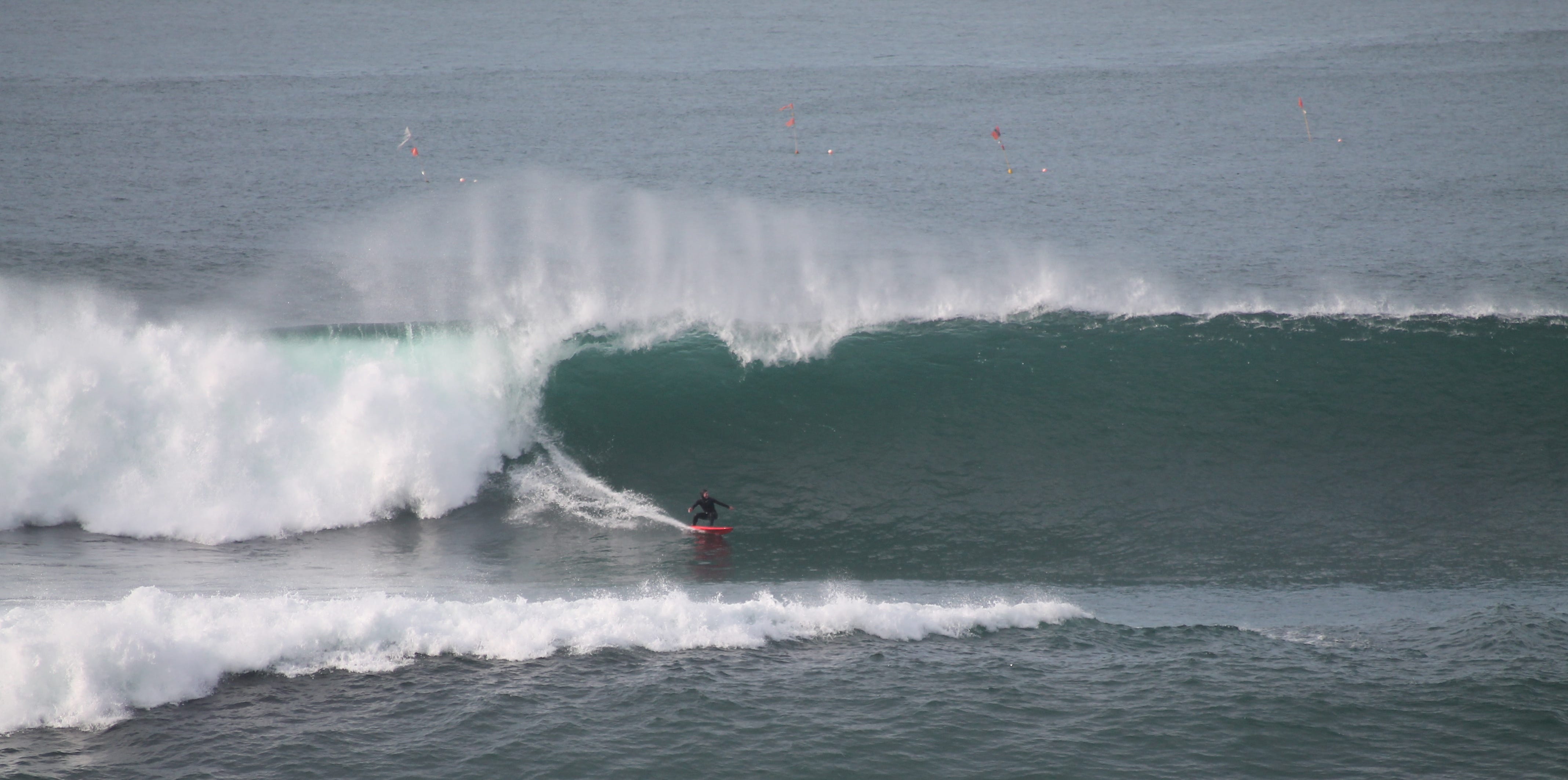
BUT THIS ISN’T MAVERICK’S and I’m not Jeff Clark. In fact, more than 15 years after that first day, there were still no real crowds at El Pringao. But the atmosphere definitely changed. Some of the surfers I first invited started inviting others, who invited others, and so on. For a few years, every time it broke there was always a crew out there, sometimes including people who didn’t know each other.
On the really good days you would get exclusive teams of professional surfers, along with photographers, drones and all the other paraphernalia. The pros would bring their jet skis with them, so they could get out to the break quickly and efficiently, take spectacular photos and sell them to the magazines.
Patience and ingenuity had been replaced by fossil fuels and money. Now, thanks to jet skis, the problem of how to get in and out, or what to do if you got caught inside, no longer existed.
Once, I made the mistake of politely complaining about the jet skis. But I was quickly and aggressively reminded that I was a foreigner, and, as such, I had no say in the matter. The wave belonged to them and they could do what they liked with it.
At that point I decided it was time to give up surfing El Pringao.
And at that point I also realized how valuable the memory of all those early years was, and how nobody could take that away from me. How being able to nurture a surf spot from birth, see it gradually come to life and watch it mature for more than a decade, was a privilege that not many people have. But at the same time, I realized how important it is to move on, before the bitter experiences begin to erode away the sweet ones. To keep the magic alive, you have to learn to let go at the right moment.
EPILOGUE: Alright, you might think that was a bit selfish. I mean, just give up surfing a place because you can’t have it to yourself anymore, and because some prick hurt your feelings? Well, in the end, El Pringao seemed to fade out of the limelight, maybe because those narcissistic surfers realized that any photos of them at El Pringao looked pathetic up against Nazaré, Jaws or giant Maverick’s. So, I didn’t give up surfing El Pringao forever. I went back there in 2024, with four people in the water and a good atmosphere. When I got out of the water that day, knowing that there would be a next time and a next, and a next, I almost felt as happy and excited as I did on that first day, 20 years earlier.